Printable PDF Edition
For readers who prefer putting pen to paper.
- Printable US Letter pages
- Clear exercises and writing spaces
- Ideal for personal reflection
- Works at home without specialized software
- Can be printed again for personal use
A research-informed approach to emotional spending
Ever bought something after a stressful day, only to wonder why you wanted it in the first place?
Spending isn't always about what we need. Sometimes it's about what we're feeling.
Discover a more thoughtful way to understand your spending habits, recognize emotional triggers, and make money decisions that align with what matters to you.
$19.99 — One-Time Purchase
Includes both the Printable PDF and Fillable PDF editions.
Grounded in behavioral science and consumer psychology, with scientific references included.
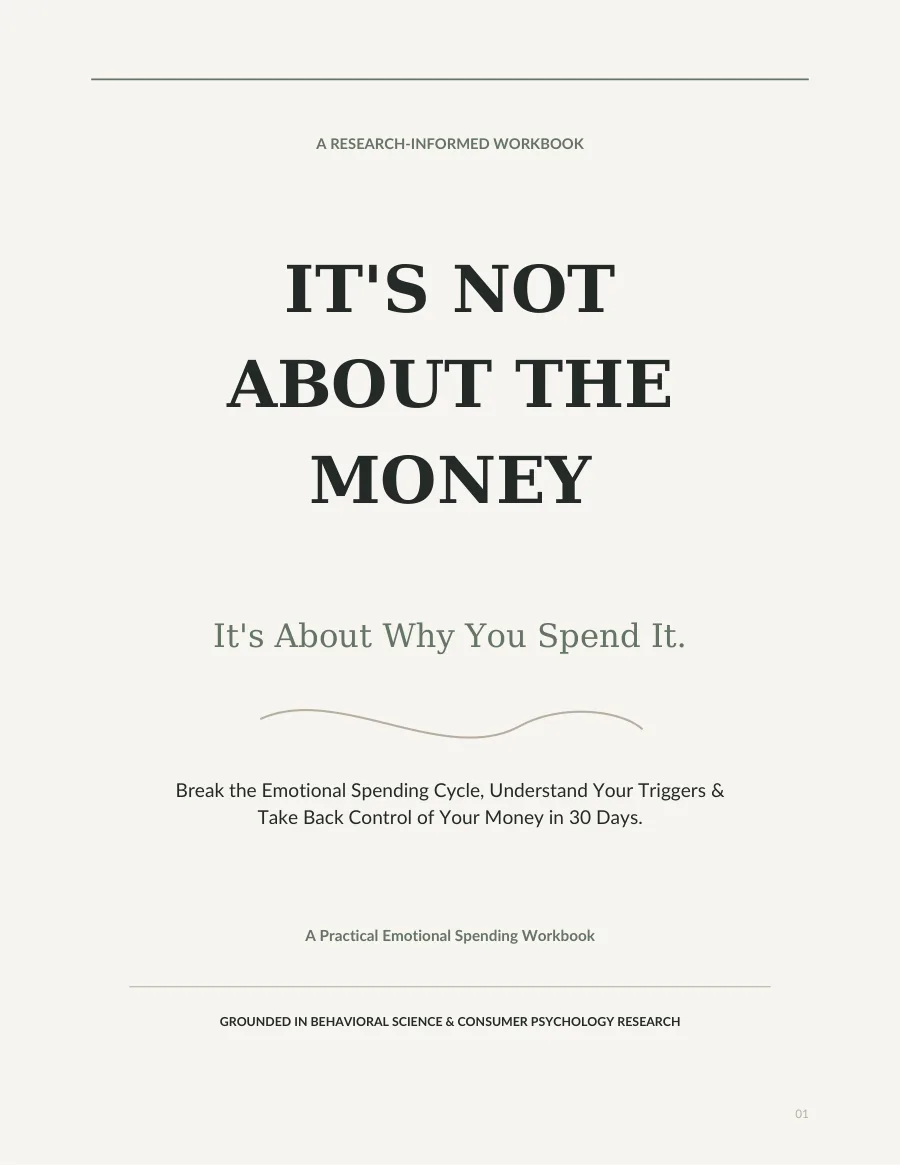
You know how to make a budget. But what happens when stress, boredom, frustration, or the need for comfort makes spending feel like the easiest answer?
Understanding the numbers is useful. Understanding what happens before a purchase can open up entirely new choices.
This workbook helps you explore the connection between your emotions, habits, and spending decisions.
Traditional budgeting tools help you organize where your money goes. This workbook explores another question: What makes you want to spend in the first place?
Explore concepts informed by published research in consumer psychology, emotional regulation, impulse buying, and habit formation. Scientific references are provided so you can explore the research behind the ideas.
Go beyond reading. Use guided worksheets, reflection prompts, trigger mapping, purchase-delay exercises, and personal spending boundaries to put what you learn into practice.
Follow a manageable four-week program designed to help you notice patterns, understand needs, practice different responses, and create a sustainable routine.
Use the included trackers, weekly reflections, self-assessment tools, and 90-day roadmap to keep learning beyond the first month.
Records what you bought, when, and how much it cost.
Explores what you were feeling, what you hoped for, and what you might try next time.
A budget shows you what you spent. This workbook helps you explore why.
Built on research, designed for real life
This workbook draws on established ideas from behavioral science and consumer psychology, including research on buying impulses, emotion regulation, habits, and financial well-being.
Rather than presenting complicated academic theory alone, it translates these concepts into accessible questions, practical exercises, and real-life reflection tools.
Explore how emotions, expectations, and buying impulses can shape decisions.
Learn to recognize emotional needs and consider responses beyond automatic purchasing.
Experiment with cues, planning, and routines that support more deliberate choices.
The workbook includes 17 scientific references. The educational methods draw on relevant research; the workbook's specific 30-day program has not been independently clinically validated.
Explore a selection of real pages, tools, and exercises from the workbook.
Page 6: The Emotional Spending Cycle
Page 12: Personal Trigger Mapping Worksheet
Page 21: The Pause-Before-Purchase Toolkit
Page 25: Your 30-Day Emotional Spending Reset
Page 43: Urge Surfing and Purchase Delay Worksheet
Page 44: Weekly Reflection and Progress Dashboard
Page 45: Thirty-Day Habit Tracker

Ready to explore your own spending patterns?
Get the Complete Workbook — $19.99Observe your spending patterns and the emotions behind them.
Explore your triggers, automatic thoughts, and the needs purchases appear to meet.
Practice thoughtful pauses, alternative strategies, and flexible decision-making.
Build practical spending boundaries and a routine you can maintain.
30 days of structured practice. Tools to keep using afterward.
A 90-day roadmap helps you stabilize, adjust, and maintain what you learn. People change at different rates, so the program offers practice rather than a fixed outcome.
The PAUSE method
PAUSE is the workbook's original five-step tool for noticing an urge and choosing what to do next. Buying always remains an option.
Close the checkout screen or stop scrolling for one deliberate moment.
Try “I feel tired and overlooked,” instead of “I need this now.”
Ask if you need rest, control, connection, novelty, convenience, or a real item.
Try an accessible alternative or a self-chosen waiting period.
Consider total cost, urgency, use, and personal priorities. Choose without self-attack.
After a tense call, a reader wants expensive shoes. They name frustration, notice they need a sense of control, go for a short walk, then check the purchase against current obligations. Either a delayed purchase or a decision not to buy can be thoughtful.
PAUSE is a self-reflection and planning tool inspired by wider research. It has not been independently tested or validated as a treatment.
For readers who prefer putting pen to paper.
For readers who prefer working digitally.
Both versions included for $19.99. No subscription required.
You receive digital PDF files, not a physical book.
Everyone starts from different circumstances. These are the skills the workbook helps you explore and practice.
Emotional spending means making a purchase partly to manage or change an emotional state, such as seeking comfort, relief, reassurance, or celebration. It is a practical description rather than a diagnosis, and an emotional motive does not automatically mean a purchase was a problem.
It is designed for adults who want to understand emotionally motivated purchases, impulse shopping, or stress-related spending, or who find spending boundaries hard to keep when emotions run high.
A budgeting planner helps you organize where your money goes. This workbook focuses on what happens before a purchase: your triggers, feelings, expectations, and automatic thoughts, along with exercises for practicing a different response.
It is informed by published research in consumer psychology, emotion regulation, impulse buying, and habit formation, and it lists 17 scientific references. That research supports the underlying ideas. The workbook itself and its 30-day program have not been clinically validated.
No. The exercises focus on noticing and reflecting on your own decisions. Nothing requires a particular income, currency, app, or paid service.
The daily activities generally take about five to fifteen minutes, although this varies from person to person. If you miss a day, you can simply resume.
Yes. Your purchase includes both the Printable PDF and the Interactive Fillable PDF edition.
It is a digital download. You receive PDF files, and no physical book is shipped.
Payment is completed through Whop. After a successful purchase, you can access both PDF files through your Whop account. If you have any trouble, write to [email protected].
Because the workbook is delivered digitally, purchases are generally final once access has been supplied. If you experience a technical delivery problem, receive an incorrect file, or believe the product is not as described, contact [email protected] so we can review and resolve it. This does not limit any rights you have under applicable consumer protection laws.
No. It provides general education and reflection, not personalized financial advice, psychotherapy, diagnosis, or medical treatment. If spending feels uncontrollable, causes severe distress, involves concealment, or threatens basic needs, consider a qualified mental health professional and, when appropriate, a nonprofit or regulated debt adviser.
You don't have to eliminate every emotional purchase or become a perfect spender. Start by understanding your patterns and practicing decisions that feel more intentional.
$19.99
One-time payment · Two PDF editions · 30-day guided workbook
Payment securely processed through Whop.